The proper management of wastewater in the food processing industry is crucial, not only for regulatory compliance but also for the sustainability of business operations and environmental preservation. As the food industry continues to innovate, so does the technology for wastewater treatment. Tonight, let’s suspend disbelief and imagine we’re deep in the bowels of a bustling factory. Tongue to teeth, let’s discuss advanced solutions for managing wastewater in the food processing industry.
The Unique Challenge of Wastewater in Food Processing
The food processing industry creates a vast amount of wastewater rife with organic material and nutrients. Depending upon the type and source of food product, the wastewater can also contain fats, oils, and greases, suspended solids, and substantial levels of biological oxygen demand (BOD) and chemical oxygen demand (COD). Removal of these elements is necessary before the water can be safely discharged into local waterways or reused within the plant.
Primary Treatment Technologies in Use
Much of the treatment is achieved via primary and secondary treatments. Primary treatment targets larger particles through physical processes such as screening, sedimentation, and flotation. It leads to a reduction of up to 60% of the solids and 35% BOD.
Meanwhile, secondary treatment includes the implementation of biological processes to decrease the remaining pollutants. This step can help remove up to 85% of the remaining BOD and COD.
The third approach involves advanced or tertiary wastewater treatment, which is gaining traction in many food processing plants for its advanced treatment capabilities and the potential for making industrial operations ‘greener.’
The Rise of Advanced Treatment Solutions
Advanced wastewater treatment is an additional step beyond using traditional biological processes and mainly targets the removal of nutrients (nitrogen and phosphorus), heavy metals, or micropollutants in the wastewater.
This is where technologies like membrane bioreactors (MBRs), ultrafiltration (UF), ultraviolet (UV) disinfection, and reverse osmosis (RO) come to the fore. These technologies represent a quantum leap in the wastewater treatment food industry.
For instance, MBR technology is a combination of a membrane process like microfiltration or ultrafiltration with a suspended growth bioreactor. If you’re itching for more technical details about how it works, you might find this resource worth the read.
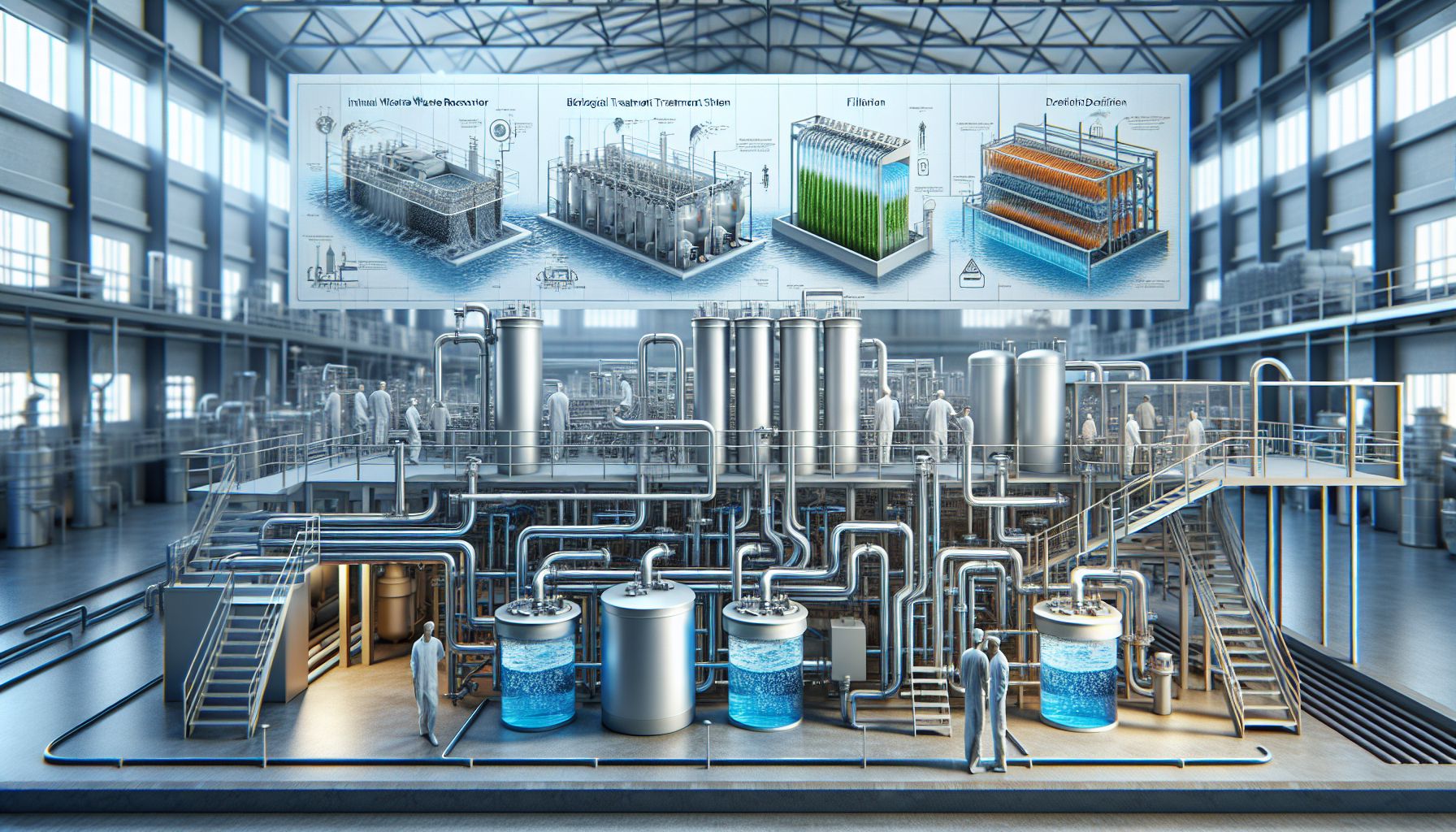
Additionally, UV disinfection is a physical process that inactivates pathogens in the water without the addition of any chemicals. UF, a type of membrane filtration, removes suspended solids and other large particles from wastewater. Lastly, RO offers a robust, chemical-free way to remove dissolved salts and contaminants from the wastewater, rendering it suitable for reuse.
The Potential for Water Reuse
What’s more, advanced wastewater treatment solutions can play a significant role in water conservation efforts. The Perrier Vittel Group, for example, uses RO systems to treat and recycle rinse water at its bottling plants in France [^1^]. By reusing treated wastewater, food processing companies can not only reduce their water consumption but also reduce the volume of contaminated water discharged into the environment.
The Role of Regulation in Advancing Solutions
Stringent regulatory frameworks play a large role in the adoption of advanced wastewater treatment technologies. Government rules and regulations, such as those imposed by the US Environmental Protection Agency (EPA), typically require food processors to implement pre-treatment processes before discharging their wastewater into municipal sewers.
And yet, are we not left with something to chew on here? Could it be that regulation, while often seen as a burden, could also be a catalyst for positive change and innovation in the industry? As regulations become more rigorous, it’s likely that the need for advanced wastewater treatment technologies will only continue to increase.
Conclusion
As we ascend from the factory floor, it becomes clear that the food processing industry’s approach to wastewater treatment is no mere afterthought. It is a complex, innovative field that touches on everything from regulations to the wise stewardship of our resources. The adoption of advanced wastewater treatment technologies is ultimately a win-win situation for both food processing companies and the environment.
[^1^]: Perrier Vittel. (2022). Reverse Osmosis systems. Perrier Vittel Group.